
Blog
 29/04/2026
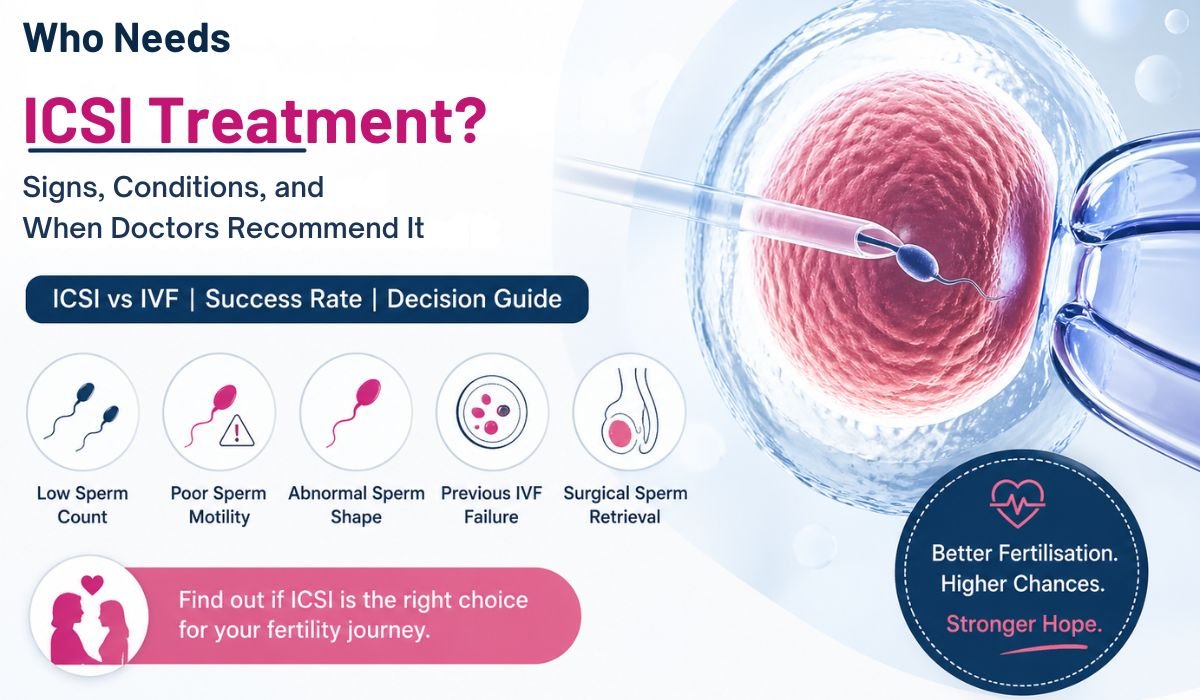
IVF fail ho gaya? Doctor suddenly ICSI bol raha hai, lekin aap confused hain?
You are not alone. Thousands of couples in India face the same confusion: “What is the difference between IVF and Intracytoplasmic Sperm Injection (ICSI)? Do we really need ICSI? Or is IVF enough?”
This confusion leads to wrong treatment choices, wasted money, and months of emotional stress.
Let us settle this today. You will learn exactly who needs ICSI treatment, what signs to look for, and when doctors recommend this advanced fertility treatment in India – without any fluff.
In simple words we say ICSI is a fertility treatment where a single sperm is directly injected into an egg to achieve fertilisation.
If you are short on time, here is the direct answer:
Men with very low sperm count (less than 15 million per ml)
Men with poor sperm motility (sperm cannot swim)
Men with abnormally shaped sperm (failed natural penetration)
Couples who had previous IVF failure (no fertilisation or poor embryo development)
Men requiring surgical sperm retrieval (TESA, PESA, Micro-TESE)
Couples with unexplained infertility after 1–2 failed conventional IVF cycles
Keep reading for detailed explanations and a simple decision guide.
ICSI (Intracytoplasmic Sperm Injection) is a specialised form of IVF. In conventional IVF, many sperm are placed near the egg. In ICSI, a single healthy sperm is injected directly into the egg. That is the only difference – but it changes everything for male infertility treatment.
The ICSI procedure is performed by an embryologist using a high-powered microscope and a fine glass needle.
Low sperm count (oligospermia) – Less than 15 million per ml makes natural fertilisation difficult. The ICSI procedure needs only one sperm per egg.
Poor sperm motility (asthenozoospermia) – If sperm cannot swim, they cannot reach the egg naturally. ICSI removes the need to swim.
Abnormal sperm shape (teratozoospermia) – Odd-shaped sperm fail to penetrate the egg. ICSI lets the embryologist pick a normal-looking sperm and inject it directly.
Some couples complete a full IVF cycle, but no eggs fertilise. That is called total fertilisation failure. If this happens, doctors recommend ICSI in the next cycle. Fertilisation rates often jump from 0% to 60–80%.
Poor embryo development is another sign. ICSI can help by selecting the most competent sperm.
Some men have no sperm in their ejaculate (azoospermia) due to a blockage. Sperm is still produced inside the testicles. Doctors retrieve it surgically using TESA, PESA, or Micro-TESE. That retrieved sperm cannot swim or fertilise naturally. ICSI is mandatory here.
All reports are normal – semen analysis, ovarian reserve, tubes, hormones – yet pregnancy does not happen. After one or two failed conventional IVF cycles, doctors often move to ICSI. It removes microscopic barriers that standard IVF cannot overcome.
Trying for over two years with no success.
Partner’s semen analysis shows low count, poor motility, or abnormal forms (especially two or more issues).
A previous IVF cycle had no fertilisation or very few fertilised eggs.
Partner had a vasectomy, testicular injury, or sperm retrieval surgery.
You or your partner carry a genetic condition affecting sperm quality.
If any of these signs sound familiar, discussing ICSI treatment options in detail with a fertility specialist is the right next step.
Here is a simple comparison:
Feature: How sperm meets egg
Conventional IVF: Many sperm near the egg; one enters naturally
ICSI Treatment: One sperm injected directly into the egg
Feature: Sperm requirement
Conventional IVF: Normal count, motility, shape needed
ICSI Treatment: Even one healthy sperm per egg is enough
Feature: Best for
Conventional IVF: Female infertility (tubal, ovulation issues)
ICSI Treatment: Male infertility, previous IVF failure
Feature: Fertilisation rate per egg
Conventional IVF: 50–70%
ICSI Treatment: 60–80%
Feature: Risk of fertilisation failure
Conventional IVF: Present
ICSI Treatment: Very low
Feature: Cost (approx, India)
Conventional IVF: ₹1.5–2.0 lakhs
ICSI Treatment: ₹2.0–2.8 lakhs
Feature: Lab skill required
Conventional IVF: Less
ICSI Treatment: Highly skilled embryologist needed
This advanced fertility treatment in India – Intracytoplasmic Sperm Injection (ICSI) – is often recommended for specific situations. Here is a simple guide.
Quick decision table:
Your Situation: Male infertility (low count, poor motility, bad shape) → Best Option: ICSI
Your Situation: Female infertility (blocked tubes, ovulation issues) → Best Option: Conventional IVF
Your Situation: Previous IVF cycle with no fertilisation → Best Option: ICSI
Your Situation: Surgical sperm retrieval (TESA, PESA, Micro-TESE) → Best Option: ICSI (mandatory)
Your Situation: Unexplained infertility after 1–2 failed IVF cycles → Best Option: ICSI
Choose conventional IVF if:
The main problem is a female factor (blocked tubes, ovulation issues, mild endometriosis).
Semen analysis is normal or near-normal.
You have never had a failed IVF cycle.
Choose ICSI treatment if:
Male infertility is confirmed (low count, poor motility, bad morphology).
You had a previous IVF cycle with no fertilisation or very low fertilisation.
Sperm is retrieved surgically.
You have unexplained infertility and 1–2 IVF cycles have failed.
Still confused? A good doctor will not push ICSI without a reason. If your doctor recommends it but you do not fit any of the above, get a second opinion.
Success depends most on the female partner’s age. The ICSI procedure success rates below are from Indian fertility centres.
Female Age and Live Birth Rate per ICSI Cycle:
Under 30 years: 45–55%
30–35 years: 40–50%
35–37 years: 30–40%
38–40 years: 20–30%
41–42 years: 10–15%
Above 42 years: 5–10%
Condition-based variation:
Male factor, no female issues: 45–55% (under 35 years)
Previous IVF failure: 30–40%
Surgical sperm retrieval: 35–50%
Unexplained infertility: similar to age average
No ethical clinic will promise 80% or 90%. Anyone who does is misleading you.
Not guaranteed – Some eggs do not fertilise, some embryos stop growing, some pregnancies miscarry.
Emotional + physical stress – Daily injections, egg retrieval, and the waiting period are hard.
Financial factor – One ICSI cycle in India costs ₹2–2.8 lakhs plus medicines (₹30k–60k). Multiple cycles add up.
Very small increase in birth defects – Absolute risk is 2–3% vs 1–2% in natural conception. Most children are healthy.
Genetic transmission – If a father’s infertility is genetic, a male child may inherit the same condition. Genetic counselling helps.
No proper diagnosis before starting – Directly asking for ICSI without checking the female partner’s ovarian reserve, tubes, or uterus is a waste of money.
Blind trust in a single treatment – Some clinics push ICSI for everyone because it costs more. Do not accept it without a clear medical reason.
Ignoring male fertility – The female partner does all tests and all injections, but the man never gets a semen analysis. Infertility is a couple’s diagnosis.
Choosing a clinic based only on lowest cost – Cheap ICSI often means less experienced embryologists and poor lab standards. That costs more in the long run.
Not asking about add-ons – Embryo glue, time-lapse imaging, assisted hatching – ask your doctor, “Is this proven for my condition?”
Egg retrieval is done under light anaesthesia, so you will not feel pain during the procedure. Some women have mild cramping afterwards, similar to period pain.
Yes, the vast majority of ICSI babies are healthy. There is a very small increased risk of certain birth defects (2–3% vs 1–2% naturally), but absolute risk remains low.
Many couples succeed in 1–2 cycles. Around 45–55% of women under 35 succeed in the first cycle. After that, frozen embryo transfers add more chances.
Not for everyone. ICSI is better only when there is male infertility, previous IVF failure, or a need for surgical sperm retrieval. For pure female factor infertility, conventional IVF is equally good and cheaper.
Yes. If a man has no sperm at all (azoospermia not correctable), donor sperm can be used. The ICSI procedure remains the same.
ICSI is not magic. It is a tool – and tools work only when used for the right problems.
If you or your partner have confirmed male infertility (low count, poor motility, abnormal shape), a failed IVF cycle, a need for surgical sperm retrieval, or unexplained infertility after 1–2 conventional IVF failures – then ICSI treatment is your best medical option.
But if IVF has failed or sperm issues exist, delaying the right treatment only reduces your chances. Every month matters, especially as female age increases.
The single most important decision is not “ICSI or IVF?” – it is choosing a fertility centre that believes in proper diagnosis first. A good doctor will spend time on your reports, explain your options honestly, and recommend ICSI only when the evidence supports it.
Take that step – not with fear, but with clarity. Learning more about advanced ICSI procedures can help you ask the right questions and move forward confidently.



Ph: +91-562-260-0537, +91-7060301888
Address: Rainbow IVF 4th Floor, Ujala Cygnus Rainbow Hospital, NH-19, Near Guru ka Taal, Gurudwara, Sikandra, Agra, Uttar Pradesh 282007


