
Blog
 12/08/2026
Medically Reviewed By: Prof. Dr. Jaideep Malhotra, Director – ART, Rainbow IVF & Head, Department of Reproductive Medicine, Ujala Cygnus Rainbow Hospital, Agra
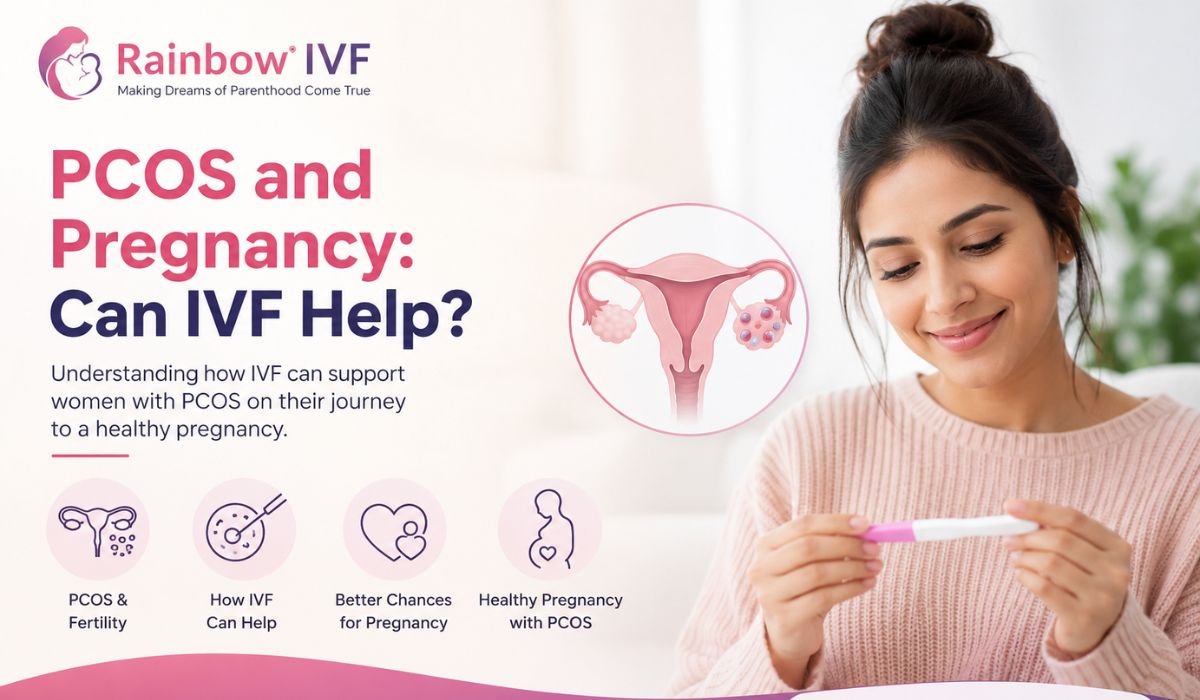
If you have recently been diagnosed with PCOS (Polycystic Ovary Syndrome) and are wondering what it means for your chances of getting pregnant, you are not alone — and you are not without options. PCOS is one of the most common hormonal conditions affecting women of reproductive age, and while it can make conception more challenging, it does not automatically mean infertility.
Many women with PCOS conceive naturally, some need a gentle nudge from ovulation-supporting medication, and others benefit from more advanced fertility treatment such as IUI or IVF. IVF may be considered when other approaches have not worked, or when additional fertility factors are involved — but it is not the automatic first step for every woman with PCOS. This article walks you through how PCOS affects fertility, when treatment may be recommended, and how IVF fits into the picture.
Yes — many women with PCOS get pregnant, both naturally and with medical support. PCOS is a hormonal condition in which the ovaries may develop multiple small follicles and struggle to release an egg regularly each month. This irregular or absent ovulation is the main reason PCOS is linked to fertility difficulty, rather than the condition making pregnancy impossible.
Because ovulation may not happen every cycle, periods are often irregular, unpredictable, or occasionally absent, which can make it harder to time conception. However, PCOS affects every woman differently. Some ovulate fairly regularly and conceive without treatment, while others need help re-establishing a predictable pattern. This variation is exactly why fertility care for PCOS should never be one-size-fits-all — an individual evaluation is the starting point, not assumptions based on the diagnosis alone.
PCOS can influence fertility through several interconnected factors, though not every woman experiences all of them:
It’s worth emphasising that having PCOS does not mean a woman will experience every one of these challenges. A proper fertility evaluation helps identify which factors are actually relevant to your individual situation.
Not every woman with PCOS needs fertility treatment to conceive. However, it may be worth consulting a fertility specialist if:
Every treatment decision should be based on a complete and individualised fertility evaluation — not simply the presence of a PCOS diagnosis. A fertility specialist will look at your full history, ovulation pattern, partner’s fertility factors, and any previous treatment before recommending a path forward.
Yes, IVF can help many women with PCOS, particularly when irregular ovulation, previous unsuccessful treatment, or additional fertility factors are part of the picture. IVF essentially allows doctors to take over and closely manage the steps that may not be happening reliably on their own.
During IVF, the ovaries are stimulated with fertility medication under close monitoring, mature eggs are retrieved, fertilised with sperm in the laboratory, and allowed to develop into embryos before one is selected for transfer to the uterus. Because this process does not depend on the body releasing an egg naturally each month, it can help bypass the ovulation-related hurdles that PCOS often creates.
That said, IVF is not automatically required simply because someone has PCOS. Many women achieve pregnancy through simpler approaches first, such as lifestyle adjustments, ovulation-induction medication, or timed intercourse, with IVF reserved for situations where these have not worked or where the overall fertility evaluation points toward it. To understand the full clinical process in detail, you can read more about IVF Treatment as offered at Rainbow IVF. If you would like a deeper, PCOS-specific look at this pathway, our dedicated guide on PCOS and IVF treatment covers it in more detail.
While every IVF journey is personalised, the broad steps typically include:
Because women with PCOS can respond strongly to ovarian stimulation, careful, individualised monitoring is especially important throughout this process. Your fertility team will adjust medication and timing based on how your body responds, rather than following a fixed protocol. Specific medication choices and dosages are a decision made between you and your fertility specialist based on your individual profile.
Not usually. IVF is one of several options available, and the right starting point depends on your complete fertility evaluation. Depending on individual circumstances, a fertility specialist may consider:
Understanding how these options differ can help you have a more informed conversation with your doctor — our comparison of IVF vs IUI explains the differences in approach and when each may be considered. Ultimately, the appropriate treatment sequence is decided based on your ovulation pattern, age, duration of infertility, and any other fertility factors identified during evaluation — not on a fixed rule for every PCOS diagnosis.
PCOS alone does not determine how successful IVF will be for a particular individual. Several factors influence outcomes, including:
Because these factors vary so much from person to person, a meaningful success estimate isn’t possible without a personal fertility evaluation. A fertility specialist can review your specific profile and give you a realistic, individualised sense of what to expect, rather than a generic figure.
PCOS has been associated with a somewhat higher likelihood of certain pregnancy-related concerns, such as gestational diabetes or blood pressure changes during pregnancy, in some women. However, risk varies considerably between individuals, and having PCOS does not mean complications are inevitable.
The most reassuring step you can take is consistent, appropriate prenatal care. Regular monitoring allows your medical team to identify and manage any concerns early, which generally supports a smoother pregnancy. If you have PCOS and are pregnant or planning pregnancy, discuss your individual risk profile with your obstetrician rather than relying on general information alone.
While every plan should be guided by your own doctor, some general habits that support fertility and overall health include:
These habits support your overall fertility journey, but they work best alongside — not instead of — guidance from a qualified fertility specialist who knows your medical history.
Rainbow IVF is an Agra-based fertility centre that focuses on individualised fertility care, including for women navigating PCOS-related fertility concerns. Rather than applying a single approach to every patient, the team evaluates each woman’s ovulation pattern, hormonal profile, and overall fertility picture before recommending a path forward.
As a dedicated IVF Centre in Agra, Rainbow IVF brings together fertility evaluation, ovulation management, and advanced ART services under one roof, with PCOS recognised as one of the common conditions for which these treatments may be considered. If you are in Agra or nearby and exploring your options for PCOS-related fertility care, an individualised evaluation is the most reliable way to understand what applies to you specifically.
Consider booking a consultation with a fertility specialist if:
Having PCOS does not mean you cannot become a mother. The right treatment depends on your individual fertility profile, and a fertility specialist can help determine whether natural conception, ovulation treatment, IUI, IVF, or another approach is appropriate for you.
Yes, many women with PCOS conceive naturally, especially if they ovulate regularly or with minor lifestyle support. Since PCOS affects ovulation differently in each woman, some conceive without treatment while others benefit from medical support. A fertility evaluation can clarify your individual situation.
IVF can be an effective option for many women with PCOS, but success depends on individual factors like age, egg quality, ovarian reserve, and overall health rather than PCOS alone. A fertility specialist can assess your specific profile rather than relying on general statistics.
Is IVF the first treatment for PCOS infertility?
No, IVF is usually not the first step. Doctors often consider lifestyle support, ovulation-induction medication, timed intercourse, or IUI first, moving to IVF when these approaches haven’t worked or additional fertility factors are involved.
When should a woman with PCOS see a fertility specialist?
If you’ve been trying to conceive for six months to a year without success, have persistently irregular ovulation, or have tried treatment before without success, it’s a reasonable time to consult a fertility specialist for a proper evaluation.
Does PCOS affect IVF success?
PCOS itself doesn’t determine IVF outcomes on its own. Factors such as age, egg and embryo quality, uterine health, and response to stimulation play a bigger role. Women with PCOS may also respond strongly to stimulation, so careful monitoring matters.
Can PCOS cause irregular ovulation?
Yes, PCOS commonly causes irregular or absent ovulation due to hormonal imbalance, which is one of the main reasons it can make conception more difficult. However, the degree of irregularity varies significantly between individuals.
Is pregnancy after IVF safe for women with PCOS?
Pregnancy after IVF can be safe with appropriate prenatal care and monitoring. Women with PCOS may have a somewhat higher likelihood of certain pregnancy-related concerns, so regular check-ups with your obstetrician are recommended.
What fertility treatments are available for women with PCOS?
Options include lifestyle and metabolic support, ovulation-induction medication, timed intercourse, IUI, and IVF. The right choice depends on your individual fertility evaluation, not a fixed rule based on the PCOS diagnosis alone.

Ph: +91-562-260-0537, +91-7060301888
Address: Rainbow IVF 4th Floor, Ujala Cygnus Rainbow Hospital, NH-19, Near Guru ka Taal, Gurudwara, Sikandra, Agra, Uttar Pradesh 282007


