
Blog
 19/08/2026
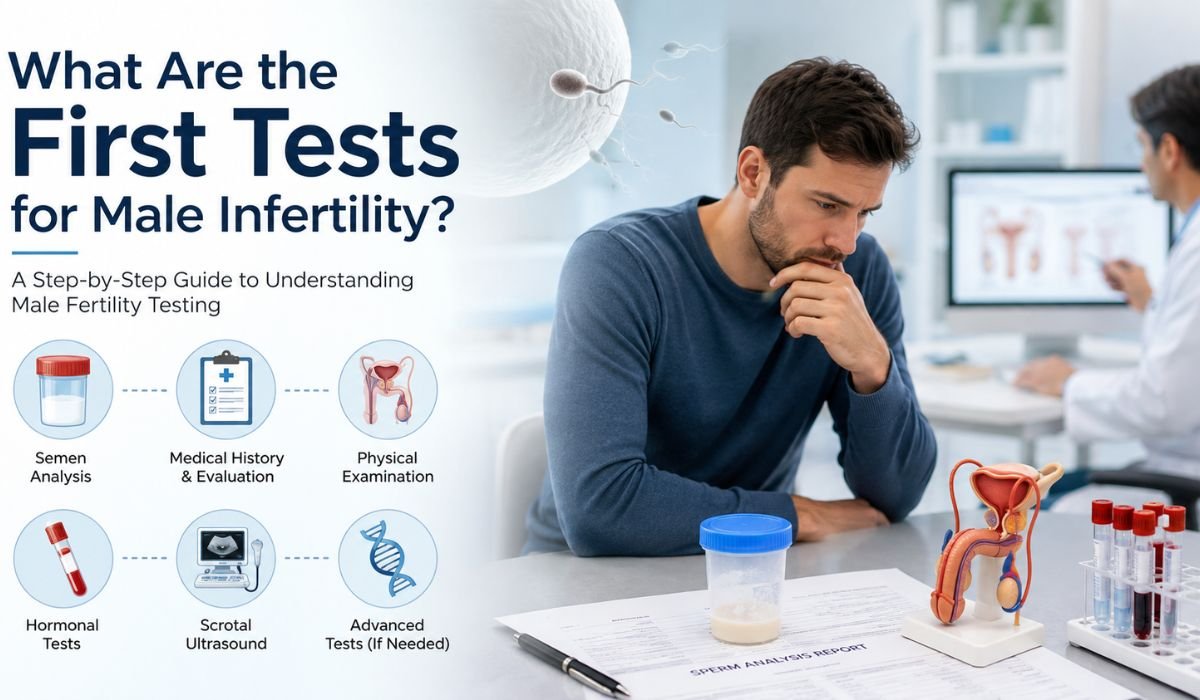
If you and your partner have been trying to conceive without success, it’s natural to wonder whether the issue could be on the male side — and if so, where testing even begins. The good news is that male fertility evaluation usually starts with simple, non-invasive steps. For most men, the first tests for male infertility are a detailed medical history, a physical examination, and a semen analysis.
Semen analysis is typically the starting point because it gives a fertility specialist useful information about sperm count, movement, and shape — the basic building blocks of male fertility. Not every man needs every test available; further investigations such as hormone testing, scrotal ultrasound, or specialised sperm-function tests are only added when the initial findings, medical history, or physical exam point toward a specific concern.
This article walks through what a male fertility work-up typically looks like, in the order it’s usually approached, so you know what to expect if you or your partner are considering evaluation.
A male fertility evaluation is individualised, but it commonly includes some combination of the following, introduced in stages rather than all at once:
Not every man will need every item on this list. A fertility specialist decides which tests are appropriate based on your individual history and initial results.
Male infertility testing is a structured way of understanding whether — and why — sperm may not be reaching or fertilising an egg effectively. It is designed to look at several different aspects of male reproductive health, including:
Because male fertility depends on several interconnected systems, testing is usually approached step by step rather than through one single test. This staged approach is part of a broader comprehensive fertility evaluation that looks at both partners, since infertility can involve male factors, female factors, or a combination of both.
For most men, semen analysis is the first and most informative test. It’s non-invasive, widely available, and gives a fertility specialist a starting picture of sperm health.
A standard semen analysis typically evaluates:
Laboratories may use slightly different reference ranges for what is considered “normal,” often based on World Health Organization guidance, so results are best interpreted by a fertility specialist rather than compared informally against numbers found online.
Semen samples are usually collected through masturbation into a sterile container, either at the clinic or at home, depending on the laboratory’s requirements. Most labs ask for a short period of abstinence beforehand — commonly a few days — because ejaculation frequency can influence the results. If home collection is used, the sample generally needs to reach the laboratory within a specific time window and be kept at an appropriate temperature. Clinic staff will usually walk you through the exact instructions beforehand, and the process is private and straightforward.
Sperm parameters can vary naturally from one sample to another due to factors like illness, stress, heat exposure, or even the abstinence period before the test. Because of this, a single abnormal semen analysis does not automatically mean a man is infertile. Fertility specialists commonly recommend a repeat semen analysis, usually several weeks later, before drawing conclusions or planning next steps. If results remain abnormal across more than one sample, further evaluation may be considered to understand the underlying reason.
Before or alongside semen testing, a fertility specialist will usually take a detailed history and perform a physical examination. This helps put the semen analysis results into context. Questions may cover:
The physical examination may look for signs such as varicocele (enlarged veins in the scrotum) or other testicular abnormalities that could be contributing to the issue. This history-taking step is a core part of a proper infertility consultation, and it often shapes which additional tests, if any, are recommended next.
Hormone testing isn’t performed for every man. It’s typically considered when the semen analysis shows a significant abnormality — such as a very low sperm count — or when the medical history or physical exam suggests a possible hormonal or testicular problem.
Hormones that may be evaluated include:
These tests help a specialist understand whether a hormonal imbalance could be contributing to reduced sperm production, rather than serving as a stand-alone diagnostic tool.
A scrotal ultrasound is an imaging test that allows a specialist to look at the structures inside the scrotum in more detail. It isn’t a routine first step for every man, but it may be recommended when there’s a specific reason to look further — for example, findings on physical examination, or semen analysis results that raise a structural question.
A scrotal ultrasound may help identify:
Not every man with fertility concerns requires this test; it is generally used selectively, based on clinical judgment.
Sperm DNA fragmentation testing looks at the integrity of the genetic material carried inside sperm — something a standard semen analysis does not measure. While a routine semen analysis looks at count, motility, and shape, DNA fragmentation testing asks a different question: is the genetic material inside the sperm intact?
This is considered an advanced or selected test, not a routine first-line investigation. A fertility specialist might suggest it in specific situations, such as unexplained infertility despite normal basic semen parameters, or recurrent pregnancy loss. It’s one of several tools used within a broader fertility diagnostic evaluation when the initial picture doesn’t fully explain the difficulty in conceiving.
Genetic evaluation is not part of a routine first work-up for most men. It becomes relevant in specific situations, including:
Whether genetic testing is appropriate — and which specific tests are relevant — is a decision made by a fertility specialist based on the individual clinical picture, not something applied uniformly to every patient.
While every case is different, a general sequence often looks like this:
This is a general framework rather than a fixed protocol that applies identically to everyone. Your specialist may adjust the order or skip certain steps depending on what earlier results show.
There’s no single universal timeline that applies to everyone, but a man may want to consider fertility testing if there is:
If any of these apply, discussing the situation with a fertility specialist consultation is a reasonable next step, so that testing can be tailored to your specific circumstances rather than guessed at.
Once test results are available, they help a fertility specialist understand what may be contributing to the difficulty conceiving — and this, in turn, guides what happens next. It’s important to know that an abnormal result doesn’t automatically mean a specific treatment is required; the appropriate next step depends on the overall clinical picture, and options can vary widely from one couple to another.
Depending on the findings, possible paths forward may include:
An abnormal semen analysis on its own does not automatically mean IVF or ICSI is required — many factors go into that decision, and it’s made jointly between you and your specialist after a full evaluation. For couples exploring their options further, learning more about male infertility treatment approaches can be a helpful next step.
Infertility can involve male factors, female factors, or both, and it’s rarely something to navigate through guesswork. If you’ve been trying to conceive and are unsure where to start, a fertility specialist can help determine which tests are actually necessary for your situation — nothing more, nothing less — and explain what the results mean for you and your partner. Reaching out for an evaluation is a practical first step toward getting clarity, without any assumptions about the outcome.
For most men, semen analysis is the first test recommended. It looks at sperm count, motility, and morphology, and gives a fertility specialist a starting point for understanding male fertility. Depending on the result and your medical history, further tests may or may not be needed.
What does a semen analysis test for?
A semen analysis typically checks semen volume, sperm concentration, motility (movement), and morphology (shape). Some labs also assess pH and other parameters. It doesn’t diagnose infertility on its own — it’s one part of a broader evaluation.
Is one semen analysis enough to diagnose male infertility?
Not usually. Sperm parameters can vary between samples due to factors like illness, stress, or the abstinence period before testing. Doctors often recommend a repeat test, generally after several weeks, before drawing firm conclusions.
When are hormone tests needed for male infertility?
Hormone tests such as FSH, LH, testosterone, and prolactin are typically considered when semen analysis results are significantly abnormal or when the history or physical exam suggests a possible hormonal cause. They aren’t a routine test for every man.
Is sperm DNA fragmentation testing necessary for every man?
No. It’s considered an advanced, selected test rather than a first-line investigation. It may be suggested in specific situations, such as unexplained infertility despite normal basic semen results
When is genetic testing recommended for male infertility?
Genetic testing is typically considered in specific cases, such as very low sperm counts or azoospermia, or when a genetic condition is suspected based on history. It’s not a routine part of initial testing for most men.
Can male infertility be diagnosed without a semen analysis?
Semen analysis is generally considered a foundational part of male fertility evaluation because it gives direct information about sperm health. While history and examination provide important context, semen analysis is usually needed to complete the picture.
When should a man see a fertility specialist?
It’s reasonable to consider a consultation if a couple has been trying to conceive for a prolonged period without success, or if there’s a known risk factor such as prior testicular injury, surgery, suspected varicocele, or a previous abnormal semen report.




Ph: +91-562-260-0537, +91-7060301888
Address: Rainbow IVF 4th Floor, Ujala Cygnus Rainbow Hospital, NH-19, Near Guru ka Taal, Gurudwara, Sikandra, Agra, Uttar Pradesh 282007


