
Blog
 17/11/2026
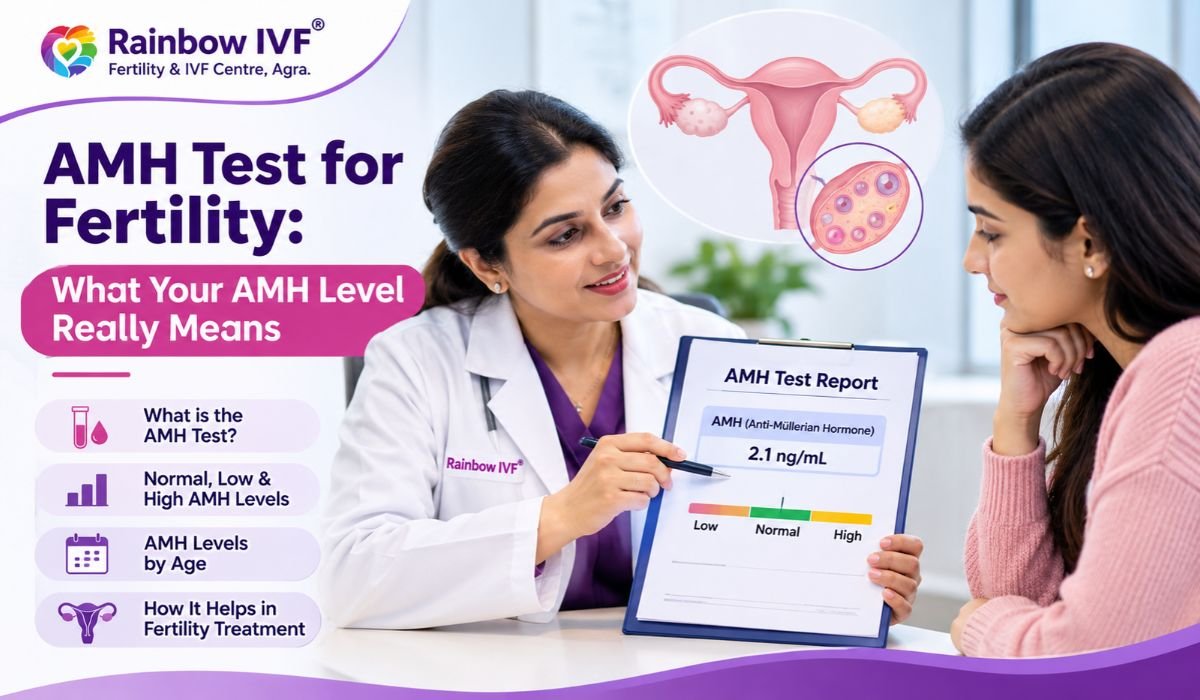
You open your lab report and see a number next to “AMH.” Is it good? Is it low? Should you be worried? It is a very common moment, and the confusion is understandable. The AMH test for fertility measures Anti-Müllerian hormone, a marker doctors use to estimate ovarian reserve, which is the number of eggs remaining in the ovaries. It gives useful clues about egg quantity and how the ovaries may respond to fertility medicines. What it cannot do on its own is tell you whether you will conceive naturally or through IVF.
This guide explains what AMH is, how the test works, what different results may mean and what to do next.
Anti-Müllerian hormone (AMH) is a hormone produced by the granulosa cells of small, developing follicles in the ovaries. Each follicle is a tiny fluid-filled sac that may contain an egg. The more small follicles a woman has, the more AMH is generally released into the blood.
Because of this link, AMH is used as a marker of ovarian reserve. Fertility specialists find it useful for several reasons:
AMH is not a measure of overall fertility. Your tubes, uterus, partner’s sperm health, ovulation and age all matter too. You can read about the common causes of female infertility to see how many factors are involved.
Yes. The AMH blood test needs a small sample drawn from a vein in your arm, much like any routine blood test. It takes only a few minutes and feels like a brief pinch. The sample is analysed in a laboratory.
Fasting is generally not required for AMH. However, laboratories differ, and you may be having other tests at the same time that do need fasting. Follow the instructions given by your laboratory or doctor.
AMH levels are relatively stable through the cycle, so the test can usually be done on most days. Your doctor may still ask you to test on a particular day if other hormone tests are planned alongside it.
Many laboratories report results within a day or a few days, but turnaround varies by laboratory and testing method. Ask the lab when to expect your report.
There is no single “normal” AMH number that applies to every woman. Results depend on age, the laboratory and the assay method used, and individual circumstances. Units can also differ (ng/mL or pmol/L), so a number from one lab cannot always be compared directly with another.
For this reason, your report should be read against the lab’s own reference data and your clinical picture, not against a figure found online.
| AMH Result | General Interpretation |
|---|---|
| Lower than expected | May indicate reduced ovarian reserve |
| Within the expected range | May suggest an ovarian reserve appropriate for the relevant age group |
| Higher than expected | May indicate a higher follicle count and can sometimes be associated with PCOS |
No AMH value guarantees fertility, and no value guarantees infertility. It is one piece of information.
Women are born with a finite number of eggs, and the number declines over time. AMH generally reflects this, so levels tend to be higher in younger women and lower as age advances. The pattern is gradual, and individual variation is wide: some women have higher or lower levels than most others of the same age.
Here is how age and AMH are generally understood to relate:
| Age Group | What to Know |
|---|---|
| Under30 | Ovarian reserve is usually higher, though some young women have low AMH and some have high AMH due to conditions such as PCOS |
| 30 to 35 | A gradual decline in ovarian reserve is common; results vary widely between individuals |
| 35 to 40 | Decline in both egg quantity and egg quality tends to become more noticeable |
| After 40 | AMH is often lower; age becomes a very important factor in chances of conception |
We have deliberately not listed age-specific numeric ranges. Reference ranges differ between laboratories and populations, and a “normal AMH by age” chart from one source may not match your lab’s method. Your fertility specialist can interpret your result using appropriate reference data and your overall assessment.
A low AMH level suggests that the number of remaining eggs may be lower than expected for your age. This is often described as diminished ovarian reserve.
Possible reasons include:
Does low AMH mean you cannot get pregnant?
No. Low AMH reflects egg quantity, not whether an egg can result in a healthy pregnancy. Many women with low AMH conceive naturally. It does not mean infertility, and it does not mean you are in menopause or about to be.
That said, if you have been trying to conceive for some time, especially if you are over 35, a low result is a good reason to seek a timely fertility evaluation rather than wait. Learning about the signs of low ovarian reserve can help you understand what else to look out for. If treatment is being considered, our guide on low AMH and IVF treatment explains the options in more detail.
A higher-than-expected AMH usually means there are many small follicles in the ovaries. In some women this is a normal variation. In others, it is associated with Polycystic Ovary Syndrome (PCOS), a condition in which ovulation may be irregular.
It is important to understand that high AMH does not automatically mean better fertility. If ovulation is irregular, conceiving can be harder despite a large number of follicles.
High AMH alone also does not diagnose PCOS. Doctors usually look at menstrual pattern, signs of raised androgens (such as acne or excess hair growth), ultrasound findings and hormone tests together. If you would like to know more about how this condition affects conception, read our article on PCOS and pregnancy.
This is one of the most misunderstood points. AMH is mainly a marker of egg quantity, not egg quality.
| Egg Quantity | Egg Quality | |
|---|---|---|
| What it means | How many eggs remain in the ovaries | Whether an egg has the potential to fertilise and develop into a healthy embryo |
| Does AMH reflect it? | Yes, it is a useful indicator | Not directly |
| Main influencing factor | Age, medical history, ovarian surgery | Age is the most important known factor |
In practice:
The (ACOG) also highlights the limitations of AMH testing, particularly when using it to predict a woman’s natural fertility potential.
AMH is rarely used alone. Doctors combine it with other tests to build a fuller picture.
| Test | What It Helps Assess |
|---|---|
| AMH | Ovarian reserve |
| AFC (antral follicle count) ultrasound | Number of visible small ovarian follicles |
| FSH | Hormonal information related to ovarian function |
| Estradiol | Hormonal activity |
| TSH | Thyroid function relevant to reproductive health |
An AFC ultrasound counts the small follicles directly, while AMH estimates the same thing through a blood marker. FSH and estradiol are usually interpreted together and are timed to a specific day of the cycle. Thyroid problems can affect cycles and conception, which is why TSH is commonly included.
Beyond hormones, a complete evaluation may include checks of the fallopian tubes and uterus, and a semen analysis for the partner. See how fertility specialists diagnose infertility for a step-by-step overview.
Current evidence does not show that ovarian reserve can be reliably rebuilt. Egg quantity declines with age, and no lifestyle change has been proven to reverse this. AMH can fluctuate slightly between tests, and some temporary factors may affect readings, but this is not the same as a true increase in egg numbers.
What you can do is support your general reproductive health:
There is no strong evidence that supplements can reliably increase ovarian reserve or reverse its decline. Please avoid self-prescribing fertility supplements, as some can interact with other conditions or medicines. Discuss any supplement with your doctor first.
AMH testing is not necessary for every woman. It can be useful in situations such as:
If you are young, have regular cycles and are not facing difficulty conceiving, a routine AMH test may not add much, and a low result could cause unnecessary worry. Your doctor can advise whether it is right for you.
When IVF is being planned, AMH helps the doctor anticipate how the ovaries may respond to stimulation medicines. It can help with:
AMH cannot predict whether IVF will succeed. Age, egg and embryo quality, uterine health and sperm factors all play major roles. To see where AMH fits in the journey, read about the IVF treatment process.
There is no single number that defines a good AMH level for pregnancy. Interpretation depends on your age, the laboratory’s reference range and your overall health. Pregnancy is possible across a wide range of AMH values, so your result should always be assessed by a fertility specialist along with other findings.
Yes, many women with low AMH conceive naturally. AMH reflects egg quantity rather than egg quality or ovulation. However, if you have been trying for some time, particularly after 35, it is sensible to seek an early fertility evaluation instead of waiting for many months.
Not significantly. The test uses a standard blood draw from a vein in the arm, which feels like a quick pinch and takes only a few minutes. Some people notice mild tenderness or a small bruise afterwards, which usually settles on its own.
In most cases, yes. AMH levels are relatively stable across the cycle, so testing is generally not tied to a specific day. Your doctor may still choose a particular day if other hormone tests, such as FSH and estradiol, are being done together.
Not necessarily. Low AMH suggests a reduced number of remaining eggs, but it cannot precisely predict when menopause will occur. Menopause timing varies widely between women. If you have irregular or missed periods along with low AMH, a doctor can evaluate you further.
No. High AMH is often seen in women with PCOS, but it can also occur in women who do not have it. PCOS is diagnosed using a combination of symptoms such as irregular periods, signs of raised androgens, ultrasound findings and hormonal tests, not AMH alone.
There is no reliable evidence that ovarian reserve can be rebuilt naturally. Small variations between tests can occur, but they are not proof of more eggs. A healthy lifestyle supports overall reproductive health, but supplements should not be expected to raise AMH.
8. When Should You Get an AMH Test for Fertility ?
An AMH test for fertility may be recommended if you are planning pregnancy, experiencing difficulty conceiving, considering IVF or egg freezing, or have concerns about ovarian reserve. A fertility specialist can help determine whether the test is appropriate based on your age and medical history.
Not for everyone. Women who are young, have regular cycles and no fertility concerns may not need it. It can be helpful if you are older, have had difficulty conceiving, have a relevant medical history or are considering egg freezing or IVF.
Avoid panic. A low result is one piece of information. Share the report with a fertility specialist, who can look at your age, AFC, cycle history and partner factors, and discuss whether to try naturally, begin treatment sooner or consider options like egg freezing.
The AMH test for fertility is a useful way to understand your ovarian reserve, but it is only one part of a complete fertility assessment. A single result cannot determine whether you will conceive. Age, antral follicle count, medical history, ovulation, tubal and uterine health, and your partner’s fertility all contribute.
Whether your result is low, within the expected range or high, the most helpful next step is to have it explained in the context of your own situation. This allows you to make informed, unhurried decisions about trying naturally, further testing or treatment.
If you would like a personalised assessment, you are welcome to speak with the team at Rainbow IVF Agra. Bring your reports, and we will help you understand what they mean for you.




Ph: +91-562-260-0537, +91-7060301888
Address: Rainbow IVF 4th Floor, Ujala Cygnus Rainbow Hospital, NH-19, Near Guru ka Taal, Gurudwara, Sikandra, Agra, Uttar Pradesh 282007


