
Blog
 16/06/2026
Medically Reviewed by Dr. Jaideep Malhotra | Director ART, Rainbow IVF, Agra | MBBS, MD, FRCOG (UK)
🏥 Quick Answer
What is Low AMH? AMH below 1.0 ng/mL indicates low ovarian reserve
Can you do IVF with Low AMH? Yes — IVF is often the most effective option
Best Treatment: Customised stimulation protocol + advanced embryo selection
At Rainbow IVF Agra: Bring your AMH report, AFC scan, and fertility records — our specialists will review them and explain your realistic options
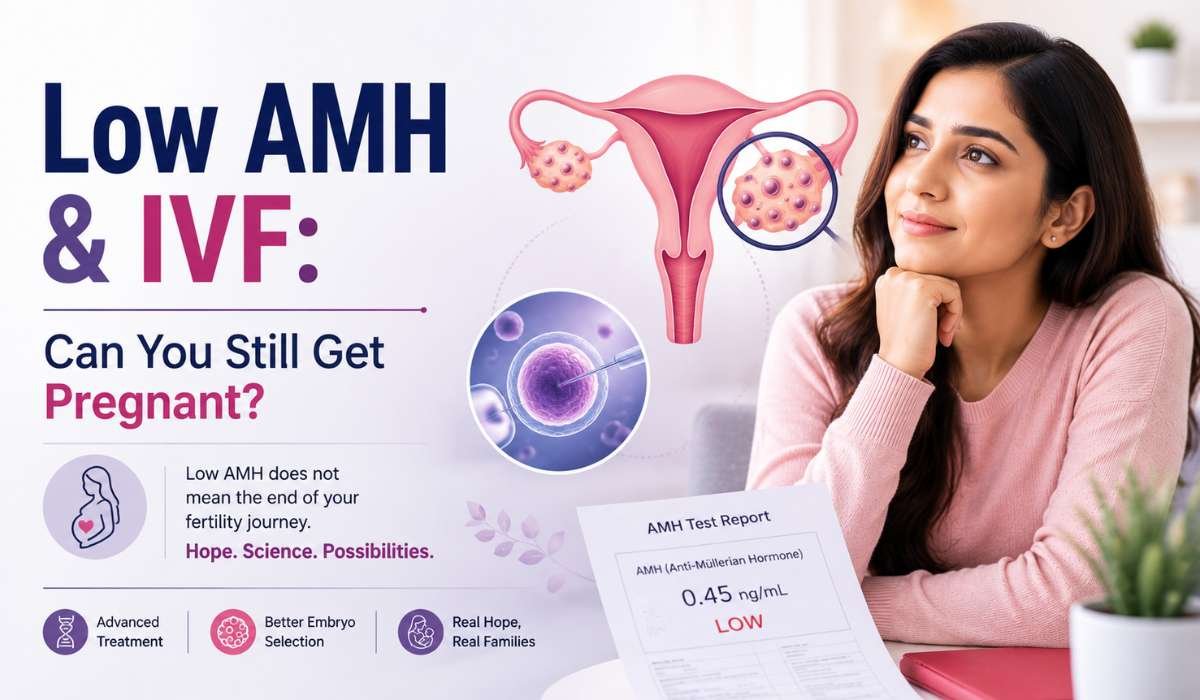
A low AMH report is one of the most devastating things a woman can receive. In a single number, it seems to summarise her entire fertility — and many women are told, incorrectly, that low AMH means they cannot have children.
This is not true.
Low AMH means your ovarian reserve is reduced. It does not mean pregnancy is impossible. Many women with low AMH — including women with AMH below 0.5 ng/mL — still achieve pregnancy with appropriate treatment every year.
At Rainbow IVF Agra, low AMH is one of the most common conditions we treat. This guide explains what AMH actually measures, what low AMH really means at different ages, and how IVF works for women with low ovarian reserve.
AMH stands for Anti-Müllerian Hormone. It is produced by small follicles in your ovaries. The amount of AMH in your blood is directly related to the number of follicles remaining — making it a reliable marker of ovarian reserve (how many eggs you have left).
AMH can be tested on any day of your menstrual cycle, making it one of the most convenient fertility markers available.
| AMH Level | Interpretation |
|---|---|
| Above 3.5 ng/mL | High (possible PCOS) |
| 1.5 to 3.5 ng/mL | Normal |
| 1.0 to 1.5 ng/mL | Low normal |
| 0.5 to 1.0 ng/mL | Low |
| Below 0.5 ng/mL | Very low |
These ranges are guidelines, not absolute cutoffs. What matters is not just the number but the full clinical picture — including antral follicle count (AFC), age, and FSH levels.
This is one of the most common questions we receive. Here is honest guidance:
AMH above 1.5 ng/mL — generally favourable. Expected to respond well to standard stimulation protocols.
AMH 1.0 to 1.5 ng/mL — slightly reduced reserve. IVF is very much possible with minor protocol adjustments.
AMH 0.5 to 1.0 ng/mL — low reserve. IVF remains a good option with a customised stimulation protocol and careful monitoring.
AMH below 0.5 ng/mL — very low reserve. IVF is still possible and is often the most appropriate treatment. Protocol selection and embryo selection technology become especially important. See the dedicated section below on very low AMH.
There is no AMH level at which IVF becomes automatically impossible. The combination of age, AFC, and clinical history matters far more than any single number.
| Factor | Low AMH | Normal AMH |
|---|---|---|
| Egg Quantity | Fewer eggs available | Normal egg count |
| Egg Quality | Depends on age — not directly affected by AMH | Depends on age |
| Natural Pregnancy | Possible, especially under 35 | Yes |
| IVF Possible | Yes — with customised protocol | Yes — standard protocol |
| Eggs Retrieved in IVF | Typically 1–5 | Typically 5–15 |
| Main IVF Risk | Poor response to stimulation | OHSS if over-stimulated |
The critical point: AMH measures quantity, not quality. A younger woman with low AMH may have fewer eggs but those eggs can be perfectly healthy — which is why age and AMH together tell a very different story than AMH alone.
Age is the most common cause. AMH naturally declines with age, accelerating after 35. However, younger women can also have low AMH — called premature ovarian insufficiency (POI) when it occurs before 40.
Endometriosis — particularly ovarian endometriomas — damages ovarian tissue and reduces AMH. Women who have had surgery for endometriosis may have lower post-operative AMH. Learn more about recurrent pregnancy loss and ovarian factors.
Previous ovarian surgery for cysts or tumours can reduce remaining follicle count.
Genetic factors including Turner syndrome and Fragile X premutation cause accelerated follicle loss.
Autoimmune conditions where the immune system attacks ovarian tissue.
Chemotherapy or radiation can significantly damage ovarian reserve.
Smoking is associated with accelerated follicle loss and lower AMH at any age.
This is the most reassuring situation. Evidence from reproductive medicine — including ESHRE and ASRM guidelines — consistently shows that women under 35 with low AMH can still achieve clinically meaningful IVF pregnancy rates because egg quality remains relatively preserved despite reduced ovarian reserve. Age is a stronger predictor of IVF outcome than AMH alone for women in this group.
If you are under 35 with low AMH, do not delay. Ovarian reserve declines over time — acting now gives you the best possible odds.
At this age, both quantity and quality begin to decline together — but IVF success with low AMH is still very achievable with the right protocol. Advanced embryo selection technology helps squeeze the maximum value out of every embryo available, which is especially important when numbers are limited.
Above 40, egg quality declines alongside low AMH. IVF with own eggs is still worth attempting for many women, particularly those with AMH between 0.5 and 1.0 ng/mL. For women over 40 with very low AMH (below 0.3 ng/mL), donor egg IVF often provides significantly better success rates and is a conversation worth having honestly with your specialist.
Searches for “AMH 0.5 IVF success”, “AMH 0.3 pregnancy”, “very low AMH IVF”, and “diminished ovarian reserve IVF” are among the most common fertility queries in India — and for good reason.
Here is what clinical evidence and experience tells us:
IVF is still possible with AMH below 0.5 ng/mL. The number of eggs retrieved may be small — sometimes just 1 to 3 — but a single good quality embryo is all that is needed for a successful transfer and pregnancy.
Protocol selection is critical. Standard stimulation doses often do not produce adequate response at this level. Experienced specialists use alternative protocols — DuoStim, estrogen priming, or mild IVF — to get the best possible result.
Multiple cycles may be needed. Some women with very low AMH bank embryos across 2 to 3 stimulation cycles before attempting transfer, building a better pool to choose from.
Donor eggs become relevant for women with very low AMH who have had repeated poor responses or multiple failed IVF cycles. This is not failure — it is a different pathway to the same destination. Read about next steps after failed IVF.
If your AMH is below 0.5 ng/mL, bring your full reports to your consultation: AMH, AFC ultrasound, FSH, LH, oestradiol, and any previous IVF records. Our specialists will give you a realistic picture and explain all options honestly.
Yes — and IVF is often the most effective assisted reproductive treatment for women with low AMH who are struggling to conceive.
IVF allows doctors to use a customised stimulation protocol to get the maximum safe response from your ovaries, retrieve and work with every egg that develops, and select the best embryo from whatever is available.
For a complete understanding of the full IVF process, read our Complete Guide to IVF Treatment in India.
Not sure whether IVF or IUI is right for you with low AMH? For most low AMH patients, IVF is significantly more efficient — read IVF vs IUI: Which Is Right for You?
There is no single “low AMH protocol.” The right approach depends on your specific numbers and clinical history:
Antagonist Protocol with Higher Gonadotropin Doses — the most common approach. Higher FSH doses recruit as many follicles as possible while an antagonist prevents premature ovulation.
Estrogen Priming Protocol — oestrogen given in the cycle before stimulation synchronises follicle growth and can improve response in women who have previously produced very few eggs.
Mini IVF or Mild Stimulation — counterintuitively, some very low AMH patients do better with gentler stimulation. This approach aims for fewer but potentially better quality eggs and is particularly considered when aggressive stimulation has repeatedly produced little response.
DHEA Supplementation — some evidence supports DHEA for 6 to 12 weeks before IVF to improve ovarian environment. Assessed individually.
DuoStim (Dual Stimulation) — stimulation twice in the same cycle, in both the follicular and luteal phases, to collect more eggs and increase the embryo pool.
When egg numbers are limited, the quality of embryo selection matters more than in standard IVF. At Rainbow IVF, our embryology laboratory uses time-lapse monitoring and AI-assisted selection technology to identify the embryo with the highest implantation potential from however many are available. When you have 2 to 4 embryos rather than 10, every selection decision carries more weight.
According to ESHRE (European Society of Human Reproduction and Embryology) and ASRM (American Society for Reproductive Medicine) guidelines, age is a stronger predictor of IVF outcome than AMH level alone — particularly for women under 35. Studies published in Human Reproduction and Fertility and Sterility have shown that women under 35 with diminished ovarian reserve can achieve pregnancy rates comparable to age-matched peers with normal AMH, particularly when stimulation protocols are appropriately tailored.
For women between 35 and 40, outcomes depend significantly on the number and quality of embryos obtained. For women over 40 with very low AMH, success rates with own eggs are more variable and donor egg options merit serious consideration.
Your individual success estimate requires a complete clinical evaluation — not a population-level statistic. At your first consultation, Dr. Jaideep Malhotra will review your specific reports and give you an honest, personalised assessment.
See also: IVF Success Rate in India: What Percentage Is Real?
Low AMH patients need more careful evaluation, more personalised protocols, and more experienced embryology support than standard IVF patients. Our approach:
Bring your AMH report, AFC scan, and previous fertility records to your first consultation. Our specialists will review them and explain your realistic treatment options clearly and honestly.
Related: How Fertility Specialists Identify the Cause of Infertility | Male Infertility Treatment in India
Yes — many women with low AMH conceive naturally, particularly under 35 with no other fertility issues. Low AMH predicts reduced reserve but does not prevent ovulation or natural conception. However, if you have been trying for 6 to 12 months without success, see a specialist promptly — ovarian reserve declines over time.
There is no universally accepted cutoff below which IVF is not attempted. Even AMH below 0.3 ng/mL does not automatically rule out IVF with own eggs, particularly in younger women. The decision is made based on AMH, AFC, age, and full clinical history together — not AMH alone.
Not necessarily. Low AMH indicates fewer eggs remaining but does not predict exactly when menopause will occur. What it does mean is that your fertility window may be shorter than average — making timely action more important.
AMH cannot be significantly raised by any current treatment. However, optimising overall health — smoking cessation, healthy weight, antioxidant supplementation, CoQ10 — may improve egg quality and ovarian environment. DHEA supplementation under medical guidance has some evidence for improving ovarian response in low AMH patients.
This varies widely. Women with low AMH may produce 1 to 5 eggs in a stimulated cycle. The antral follicle count (AFC) on ultrasound is actually a better predictor of egg yield than AMH alone. Your doctor will give a realistic expectation based on both together.
The procedure cost is the same. Higher stimulation medication doses may increase medication costs slightly. Your complete cost estimate will be provided at your first consultation. See: IVF Cost in Agra.
For most women with low AMH, IVF is more efficient than IUI. IUI relies on natural egg development — with low AMH this means fewer opportunities per cycle. IVF allows controlled stimulation and collection of all available eggs in one cycle. Read: IVF vs IUI — Which Is Right for You?
No. AMH is a female hormone with no relevance to male fertility. However, a complete semen analysis is always part of our evaluation — male factor is present in nearly 50 percent of infertility cases. Read: Male Infertility Treatment in India
A low AMH result is not the end of your fertility journey. It is information — important information — that your doctor uses to design the right treatment plan for you.
Many women with low AMH achieve pregnancy. Many with AMH below 0.5 ng/mL achieve pregnancy with appropriate treatment. The key is working with a specialist who understands low ovarian reserve and designs protocols accordingly.
Bring your AMH report, AFC scan, and previous fertility records to Rainbow IVF Agra. Our specialists will review them and explain your realistic treatment options clearly and honestly.
📞 +91-562-260-0537 | +91-7060301888
📍 Rainbow IVF, 4th Floor, Ujala Cygnus Rainbow Hospital, NH-19, Sikandra, Agra
Related Articles:



Ph: +91-562-260-0537, +91-7060301888
Address: Rainbow IVF 4th Floor, Ujala Cygnus Rainbow Hospital, NH-19, Near Guru ka Taal, Gurudwara, Sikandra, Agra, Uttar Pradesh 282007


