
Blog
 07/10/2026
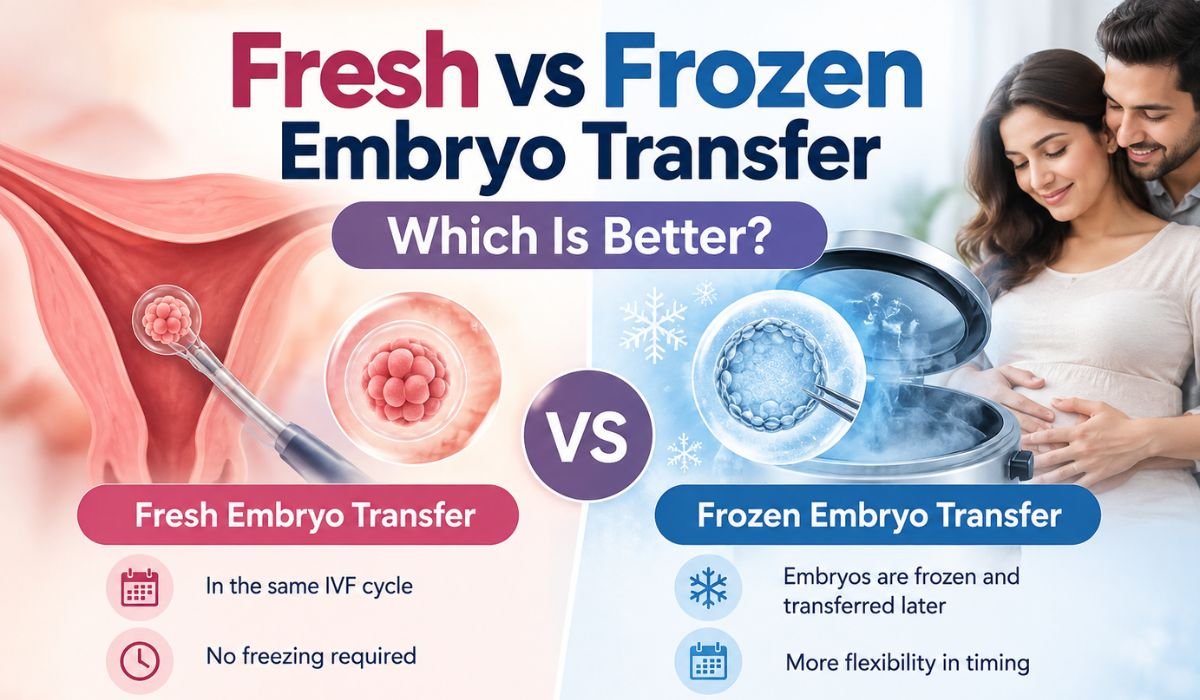
After egg retrieval and fertilization, many couples ask an important question: fresh vs frozen embryo transfer — which option is better? Should the embryo be transferred during the same IVF cycle, or should it be frozen and transferred at a later time? Both approaches can be suitable, depending on your individual treatment needs.
The choice between a fresh and frozen embryo transfer depends on several factors, including your age, embryo development, ovarian response to stimulation, hormone levels, uterine lining, risk of ovarian hyperstimulation syndrome (OHSS), and your experience with previous IVF cycles.
This guide explains how both approaches work, how they differ, what influences success, and when a fertility specialist may recommend one over the other.
A fresh embryo transfer takes place during the same IVF cycle in which your eggs were retrieved. After ovarian stimulation, the eggs are collected and fertilized in the laboratory. The resulting embryos are then monitored as they grow, and the best-suited embryo is placed in the uterus without being frozen.
Embryos usually develop in the lab for about 3 to 5 days before transfer. A Day 3 transfer involves an earlier-stage embryo, while a Day 5 transfer involves a blastocyst, an embryo that has developed further and may show clearer signs of its potential. The transfer itself is typically a short outpatient procedure using a thin catheter, followed by progesterone support to help prepare the lining for implantation.
The timing is the key point to understand. A fresh transfer happens within days of ovarian stimulation, when estrogen and progesterone levels may still be affected by the medication. That is why your doctor looks closely at your hormone levels and ovarian response before deciding whether a fresh transfer is appropriate. For a broader overview of each stage, see our IVF treatment process guide.
A frozen embryo transfer uses embryos that were created in an earlier IVF cycle, frozen, and stored until the time is right. The embryo is thawed shortly before it is placed in the uterus.
Embryo freezing is done through vitrification, an ultra-rapid cooling technique that helps prevent damaging ice crystals from forming inside the embryo. Frozen embryos are kept in cryostorage until they are needed. When you are ready, the embryo is warmed and assessed, and if it has survived thawing in good condition, it is transferred.
It helps to separate two ideas here. Embryo creation happens during your stimulation cycle, when eggs are retrieved and fertilized. Embryo transfer is the later step of placing an embryo in the uterus. With FET, those two steps happen in different cycles, so the uterus is prepared separately, either in a natural cycle or with medication.
For a detailed explanation of the procedure, preparation, timing and factors that influence FET, see our guide to Frozen Embryo Transfer (FET).
| Factor | Fresh Embryo Transfer | Frozen Embryo Transfer |
| Timing | Same IVF treatment cycle | Later cycle |
| Embryo | Transferred without freezing | Frozen and thawed before transfer |
| Ovarian stimulation | Usually recent | Completed before the transfer cycle |
| Uterine preparation | During the IVF cycle | Natural or medicated cycle |
| Additional freezing | Not required for the transferred embryo | Required |
| Flexibility | Less flexible | More scheduling flexibility |
| Extra cycle | Usually no separate transfer cycle | Requires a later transfer cycle |
| Suitable for | Selected patients | Selected patients |
This table is for general education. Individual treatment decisions vary.
This is the question most couples search for, and it deserves a careful answer. Success cannot be summed up by saying fresh is better or frozen is better. Outcomes depend on the person and the situation.
Factors that influence success in both approaches
What research generally suggests
Studies comparing the two approaches have produced different findings depending on the patient group. In many women with a typical ovarian response, live-birth rates with fresh and frozen transfer appear to be broadly similar. In women who produce a high number of eggs, including some women with PCOS, frozen transfer has in some trials been associated with better pregnancy outcomes and a lower risk of OHSS. Researchers are also still studying differences in pregnancy and newborn outcomes between the two approaches, so this remains an active area of research.
Because findings vary by population, no clinic can promise a specific result to an individual patient, and no study can tell you which route will work for you.
Know which number you are looking at
When you compare a frozen embryo transfer success rate with a fresh embryo transfer success rate, check what is being measured:
Rates may also be reported per transfer, per egg retrieval, or cumulatively across several transfers. A figure from one clinic or study cannot be compared directly with another unless the definitions match. If you see statistics, check the year and the patient age group as well. IVF success varies with factors such as age, diagnosis, embryo quality and treatment planning.
The embryo can be transferred during the same treatment cycle, so you do not have to wait for a later cycle to try for pregnancy. For some couples, a shorter timeline matters.
The selected embryo does not need to go through freezing and thawing. Modern freezing techniques are very effective, but a fresh transfer avoids that step altogether.
Fresh transfer can be a reasonable option when hormone levels, ovarian response and uterine conditions all look suitable. In those cases, there may be no medical reason to postpone the transfer.
Because embryos are stored, the transfer can be planned around your health, your schedule and your clinic’s assessment of the best time. You are not tied to the exact days of your stimulation cycle.
Ovarian stimulation temporarily raises hormone levels and can leave you feeling bloated or uncomfortable. Waiting for a later cycle allows your body to settle and lets the uterine lining be prepared in a more controlled setting.
If genetic testing such as PGT is recommended, embryos usually need to be frozen while the results are processed. A frozen transfer then allows the chosen embryo to be transferred once the testing is complete.
Freezing all suitable embryos for a later transfer may be considered in situations such as:
A fertility specialist may consider FET when:
These are not automatic indications. Each one is weighed alongside your overall picture. For example, women with polycystic ovaries often respond strongly to stimulation, which is one reason a freeze-all approach may be discussed. You can read more in our article on PCOS and IVF treatment.
A fresh transfer may be considered when:
As with FET, this is a clinical judgment made for you, not a rule that applies to every patient.
It is difficult to say one option is simply cheaper than the other, because the total cost depends on your treatment plan. Components that can affect the overall expense include:
Because freezing and FET can involve additional treatment components, couples should understand the complete IVF cost in Agra before choosing a treatment pathway. It is also worth asking your clinic whether frozen transfers from the same retrieval are likely to be needed anyway, since this affects the overall picture. Your clinic can give you an itemized estimate based on your own plan.
This is one of the most common worries about FET. Modern vitrification has become the standard method for freezing embryos, and most good-quality embryos survive the freeze-thaw process. Still, no laboratory process is risk-free, and survival depends on factors such as the stage of the embryo and the skill of the embryology team.
A few points are worth keeping in mind:
Women with PCOS often have many small follicles and may produce a large number of eggs in response to stimulation. This can raise the risk of OHSS, a condition in which the ovaries become swollen and fluid can build up in the body.
For this reason, a freeze-all strategy, where embryos are frozen and transferred in a later cycle, is sometimes considered for women with PCOS. This gives the body time to recover from stimulation. It is not the right choice for every woman with PCOS, and some may still be suitable for a fresh transfer.
The most important factor is an individualized stimulation plan with careful monitoring, so the dose and timing suit your ovarian response. Our PCOS and IVF article covers this topic in more depth.
Your fertility specialist will usually look at your results during and after stimulation. A simple way to think about it:
| Approach | May be considered when |
| Fresh transfer | Hormone levels are suitable, the uterine environment is appropriate, and there is no major medical reason to delay |
| Frozen transfer | There is a risk of OHSS, a need for PGT, an unsuitable hormonal environment, a need for additional preparation, or other clinical considerations |
The final decision should be based on your individual medical history and your fertility specialist’s assessment.
Neither is better for everyone. Some patients do well with a fresh transfer, while others benefit from freezing embryos and transferring later. Your age, embryo quality, hormone levels, ovarian response and risk of OHSS all play a part. Your doctor will recommend the approach that suits your situation.
Not always. In many women with a typical response, results appear broadly similar, while in some groups, such as high responders, frozen transfer has been linked to better outcomes. Success also depends on embryo quality, age and the clinic’s laboratory. It is important to check whether a reported rate refers to pregnancy, implantation or live birth.
Timing varies. Many frozen transfers take place in a later menstrual cycle, once the body has recovered from stimulation and the lining is ready. If genetic testing, medical treatment or personal circumstances call for a longer gap, embryos can remain stored until you are ready. Your specialist will set the timing.
Modern vitrification is designed to protect embryos during freezing, and most good-quality embryos survive thawing. However, no process is entirely without risk, and survival varies. Embryo quality before freezing and the experience of the embryology laboratory both matter.
Common reasons include a risk of OHSS, hormone levels that may not suit implantation, the need for PGT, a lining that needs more preparation, or a need to delay transfer for medical or personal reasons. These are considerations, not automatic rules.
It can involve additional costs, such as freezing, storage, thawing, medication and monitoring for the transfer cycle. However, the total cost depends on how many cycles and transfers you need. Ask your clinic for an itemized estimate covering the whole treatment plan.
Yes, if you have suitable embryos frozen from the same cycle. Your doctor will review what may have happened, check your uterine lining and hormone profile, and advise on the best timing and preparation for the next attempt. If no embryos were frozen, another stimulation cycle may need to be discussed.
A frozen transfer is often considered for women with PCOS who have a high ovarian response or an increased risk of OHSS. That said, it is not the right answer for every woman with PCOS. Treatment should be individualized and carefully monitored.
Fresh and frozen embryo transfers can both be appropriate. When people compare fresh vs frozen embryo transfer, they often look for a single winner, but there is no single option that is best for every patient.
The choice should take into account:
If you are unsure whether fresh or frozen embryo transfer is appropriate for you, discuss your IVF reports, embryo development and treatment history with a qualified fertility specialist. You are welcome to book a fertility consultation with Rainbow IVF in Agra to talk through your options.
This article is for general education and does not replace personal medical advice. Treatment decisions should be made with your fertility specialist.

Ph: +91-562-260-0537, +91-7060301888
Address: Rainbow IVF 4th Floor, Ujala Cygnus Rainbow Hospital, NH-19, Near Guru ka Taal, Gurudwara, Sikandra, Agra, Uttar Pradesh 282007


