
Blog
 26/06/2026
By Dr. Neharika Malhotra | Senior Infertility Consultant, ART Rainbow IVF Agra
Reviewed by: Prof. Dr. Jaideep Malhotra | Director ART, Rainbow IVF | Published: June 2026 |
Quick Answer — What is Frozen Embryo Transfer (FET)?
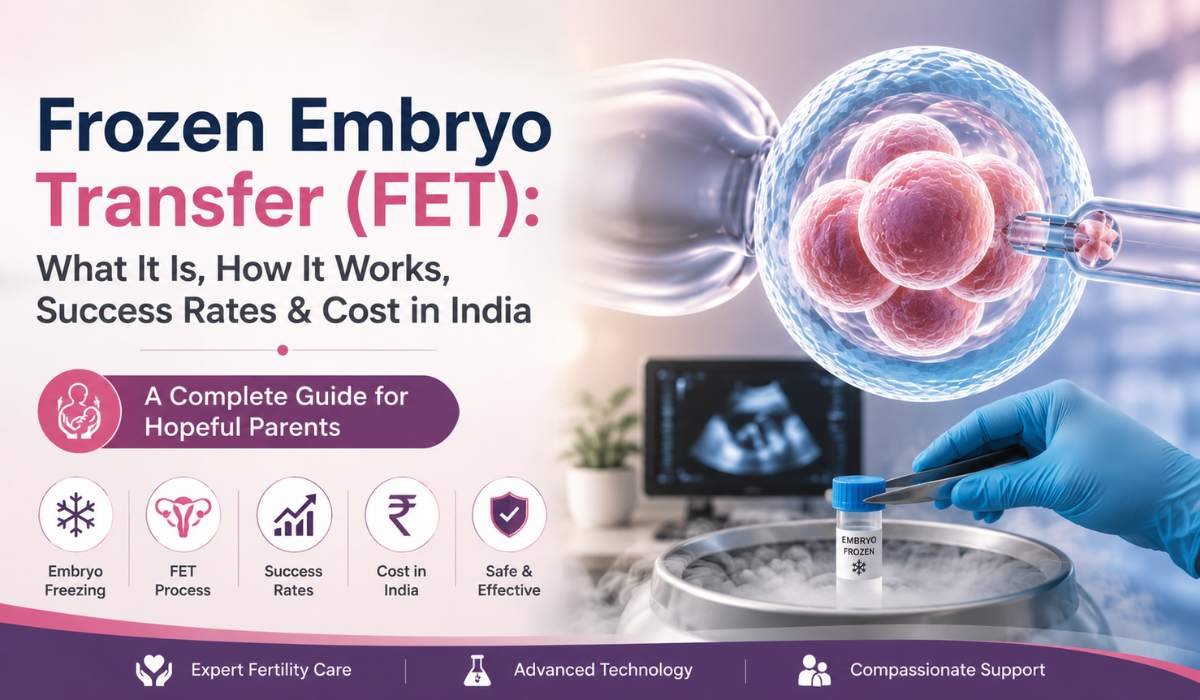
Frozen Embryo Transfer (FET) is an IVF procedure in which previously frozen (cryopreserved) embryos are thawed and transferred into the uterus. It is used when embryos are stored from a previous IVF cycle and transferred in a later, separate cycle. FET is increasingly preferred over fresh transfers in India because it allows the uterus to recover after ovarian stimulation, leads to better implantation, and often gives higher success rates — especially for patients with PCOS, thin uterine lining, or those undergoing genetic testing (PGT).
If you are going through IVF treatment in India, your doctor may have mentioned Frozen Embryo Transfer — or FET. You might have several embryos stored after your egg retrieval, or you may have had a failed fresh transfer and are wondering what comes next.
At Rainbow IVF Agra, over 60% of our embryo transfers are blastocyst frozen transfers — one of the highest rates in North India. This is not a coincidence. It reflects our clinical approach of choosing the method that gives patients the best possible chance of a successful pregnancy. This guide will explain everything you need to know about FET — from what it is, to how it works, to real success rates and cost in India.
Frozen Embryo Transfer (FET) is a procedure in which embryos that were created during a previous IVF cycle, frozen (cryopreserved), and stored are later thawed and placed into the woman’s uterus during a separate treatment cycle.
Here is how it fits into the IVF process:
The embryos can be stored at Rainbow IVF’s advanced Oocyte and Embryo Storage facility for years without quality loss, thanks to cryopreservation technology that preserves embryos at -196°C using liquid nitrogen.
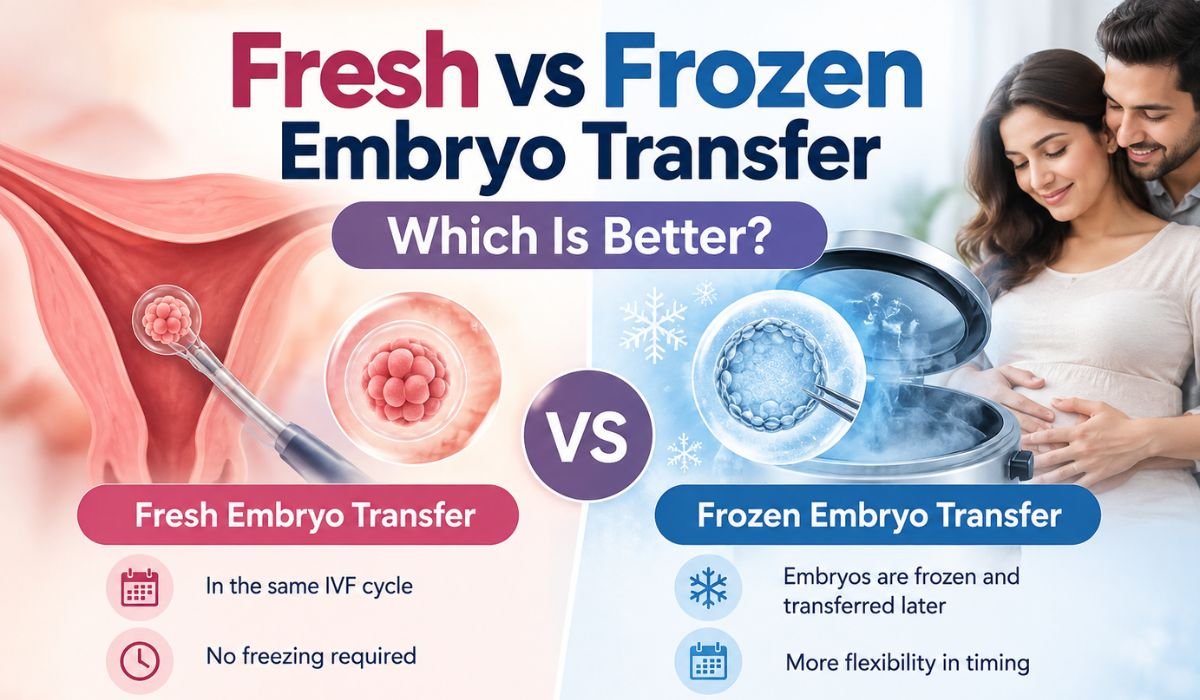
Many couples ask: should I do a fresh or frozen embryo transfer? The answer depends on your medical situation, but here is a clear comparison:
|
Factor |
Fresh Embryo Transfer | Frozen Embryo Transfer (FET) |
| When is transfer done? | 3–5 days after egg retrieval in the same cycle | In a separate cycle weeks or months later |
| Uterine environment | Affected by stimulation drugs — may not be ideal | Fully recovered, natural or prepared lining — more receptive |
| Risk of OHSS | Higher (especially in PCOS patients) | Eliminated — stimulation is complete |
| Embryo quality | Good — no freeze-thaw cycle | Excellent — vitrification survival rate >95% |
| Success rates (India) | 30–40% per cycle | 35–50% per cycle (often higher than fresh) |
| PGT-A testing possible? | Limited (requires biopsy and rapid turnaround) | Yes — embryos can be biopsied, tested, then frozen |
| Best for | Younger patients, normal responders, no OHSS risk |
PCOS, thin lining, high responders, PGT-A patients, failed fresh transfers |
At Rainbow IVF Agra, our doctors recommend FET in most cases because the frozen transfer protocol allows us to precisely time the transfer to when the uterine lining is at its most receptive — improving implantation chances significantly.
FET is not just for people who “have leftover embryos.” It is increasingly the first-choice transfer method for many clinical situations.
Women with PCOS are at high risk of Ovarian Hyperstimulation Syndrome (OHSS) after egg retrieval. A fresh transfer during an already stimulated cycle adds further risk. As we explain in our guide on PCOS and IVF treatment in India, a freeze-all strategy followed by FET is the medically safer and often more successful approach for PCOS patients.
Women with low Anti-Müllerian Hormone (AMH) often produce fewer eggs per cycle. Freezing all viable embryos and transferring the best one in a controlled FET cycle prevents wasting a precious embryo on a suboptimal uterine environment. Read our detailed guide on Low AMH and IVF for more on this.
A uterine lining of at least 7–8mm is generally needed for successful implantation. Sometimes the lining is thin after stimulation, making a fresh transfer risky. FET allows time for the lining to recover and be properly prepared. Learn more about thin uterine lining before IVF.
When embryos need to be biopsied for Genetic Screening (PGT-A/PGT-M), freezing is mandatory while results come back (typically 7–14 days). FET is then performed with the genetically screened, normal embryo — significantly improving success rates and reducing miscarriage risk.
If you had embryos remaining after a failed fresh transfer, FET is typically the next step. As our doctors explain in our guide on what to do after failed IVF, a careful review of what went wrong — lining quality, embryo grade, protocol — is done before planning an FET cycle.
For patients who have had repeated failed transfers, FET combined with advanced uterine preparation — or Ovarian and Endometrial Rejuvenation with PRP — can dramatically improve outcomes. Rainbow IVF’s Recurrent Implantation Failure protocol specifically addresses this.
Women who freeze embryos for fertility preservation before cancer treatment, surgery, or for personal reasons use FET when they are ready to conceive.
FET is a gentler, more controlled process than a full IVF cycle. There are no injections for egg retrieval. The focus is entirely on preparing the uterus.
| Step | Phase | What Happens |
|
1 |
Consultation & Review | Your doctor reviews embryo quality, previous cycle records, and decides the FET protocol (natural, medicated, or modified natural). |
|
2 |
Endometrial Preparation (14–21 days) | Estrogen tablets or patches are given to thicken the uterine lining. Ultrasound and blood tests monitor lining growth. Target: 7mm+ trilaminar lining. |
|
3 |
Progesterone Start (5–6 days before transfer) | Progesterone is added to prepare the endometrium for implantation. This mimics the natural luteal phase. Transfer date is calculated from progesterone start. |
|
4 |
Embryo Thawing (Day of Transfer) | Frozen embryo is thawed in the IVF lab. The embryologist confirms survival and quality before transfer. Vitrified embryos have >95% survival rate at Rainbow IVF. |
|
5 |
Embryo Transfer | A soft catheter is used to place the thawed embryo into the uterus — a 10–15 minute procedure, typically painless. The embryoscope monitors embryo quality before transfer. |
|
6 |
Luteal Phase Support (2 weeks) | Progesterone continues to support early implantation. Patients rest for a short while, then resume light normal activity. |
|
7 |
Pregnancy Test (Beta hCG) | A blood Beta hCG test is done 12–14 days after transfer. A positive result confirms pregnancy. An ultrasound follows at 6–7 weeks. |
Did You Know?
The FET procedure itself — the actual embryo transfer — takes only 10–15 minutes and is usually completely painless. Most patients go home within an hour and can resume desk work the same day. The preparation phase (uterine lining buildup) takes 14–21 days and is managed entirely with oral/vaginal medications or gentle injections.
There are three main ways to prepare the uterine lining for a frozen embryo transfer. Your doctor will recommend the best protocol based on your menstrual cycle regularity and medical history.
At Rainbow IVF, the medicated FET protocol is most commonly used, particularly because of our high proportion of PCOS patients and cases requiring genetic screening. Our team also uses Ovarian Stimulation protocols tailored to each patient’s hormone profile before any transfer cycle.
When embryos are frozen, they can be at different development stages — Day 3 (cleavage stage, 6–8 cells) or Day 5/6 (blastocyst stage). Rainbow IVF’s data shows 60% of transfers are blastocyst transfers. Here is why this matters.
| Day 3 Embryo Transfer | Day 5 Blastocyst Transfer | |
| Stage of development | 6–8 cells, early cleavage stage | ~100–200 cells, fully formed blastocyst |
| Implantation potential | ~20–30% | ~40–60% (significantly higher) |
| Self-selection | No — all Day 3 embryos look similar | Yes — only genetically viable embryos reach blastocyst stage |
| Natural uterine timing | Embryo arrives earlier than in nature | Matches the natural timing of embryo entering the uterus |
| PGT-A biopsy possible? | Technically possible but less accurate | Yes — outer trophectoderm cells biopsied safely |
| Risk | Some Day 3 embryos that look good fail to develop further | Fewer embryos reach blastocyst — quality is confirmed |
Our Embryoscope (Time-Lapse Monitoring System) continuously tracks embryo development from fertilization to blastocyst stage without disturbing the embryos. Combined with our AI-based Embryo Selection technology, Rainbow IVF’s embryologists can identify the single best blastocyst to transfer — maximizing FET success while minimizing risks from multiple pregnancies.
Frozen Embryo Transfer (FET) success rates in India range from 35% to 55% per cycle, depending on the woman’s age, embryo quality, uterine lining condition, and the fertility clinic’s laboratory standards. FET generally has equal or higher success rates compared to fresh transfers, particularly for patients under 35.
| Woman’s Age | FET Success Rate (India avg.) | Fresh Transfer Rate (Comparison) | Key Observation |
| Below 30 | 50–60% | 40–50% | FET often outperforms fresh |
| 30–34 | 45–55% | 35–45% | FET recommended for PCOS/PGT |
| 35–37 | 35–45% | 30–40% | PGT-A significantly boosts results |
| 38–40 | 25–35% | 20–30% | Blastocyst + PGT-A strongly advised |
| Above 40 | 15–25% | 10–20% | Donor egg FET may be considered |
Note: These are average industry estimates. Actual rates vary by clinic, protocol, and individual medical history. Rainbow IVF’s 2022 success rate across all IVF cycles was 52.4%, with blastocyst FET cycles performing at the higher end of these ranges.
What improves FET success rates?
For a deeper understanding of IVF success rates in India by age and factors, read our detailed IVF Success Rate Guide.
Preparation for FET involves both medical and lifestyle steps. Here is what Rainbow IVF advises:
Direct Answer — FET Cost in India
A Frozen Embryo Transfer (FET) cycle in India typically costs between ₹50,000 and ₹1,20,000, depending on the clinic, protocol, and any additional tests required. This does not include the initial IVF cycle cost where embryos were created and frozen. At Rainbow IVF Agra, FET pricing is transparent and discussed in detail during consultation.
| FET Cost Component | Approximate Cost (India) |
| Endometrial preparation medications (estrogen + progesterone) | ₹8,000 – ₹20,000 |
| Monitoring ultrasounds (2–3 scans) | ₹3,000 – ₹8,000 |
| Embryo thawing and preparation (lab fee) | ₹15,000 – ₹30,000 |
| Embryo transfer procedure | ₹20,000 – ₹40,000 |
| Beta hCG blood test | ₹800 – ₹1,500 |
| PGT-A genetic testing (optional, if needed) | ₹40,000 – ₹80,000 additional |
| Total FET cycle (excluding PGT) | ₹50,000 – ₹1,20,000 |
For a complete breakdown of IVF-related costs at Rainbow IVF Agra including initial cycle, medications, and add-ons, read our guide on IVF Cost in Agra.
One of the most common situations where FET is planned is after a failed fresh IVF cycle. A failed IVF cycle is not a closed door — it is information. At Rainbow IVF, we conduct a detailed review before planning any FET after failure. Here is what changes:
Read more: Failed IVF Treatment — How Doctors Decide the Next Step | IVF Failed Once or Twice — Doctor Review
Rainbow IVF is North India’s leading fertility centre for IVF and advanced reproductive treatments, located at Ujala Cygnus Rainbow Hospital, Sikandra, Agra. Here is what sets our FET programme apart:
| Rainbow IVF Advantage | Clinical Impact |
| 60% Blastocyst Transfer Rate | Higher implantation potential per transfer |
| 52.4% IVF Success Rate (2022) | Well above national average of 30–40% |
| Embryoscope Time-Lapse Monitoring | Continuous embryo quality tracking without disturbance |
| AI-Based Embryo Selection | Selects the embryo with highest implantation potential |
| RI Witness Electronic Tracking System | Eliminates sample mix-up risk in the lab |
| PRP Endometrial Rejuvenation | Improves lining for difficult cases and thin endometrium |
| 12,500+ Happy Families | 4.9★ Google (828 reviews) | Proven clinical experience and patient trust |
Patients travel from Mathura, Firozabad, Aligarh, Bharatpur, Etah, and across Uttar Pradesh and Rajasthan to Rainbow IVF for advanced IVF and FET care. Read why: IVF near Mathura | IVF near Firozabad
To start your FET journey or for a second opinion on a failed cycle, book a consultation at Rainbow IVF Agra today.
In many cases, yes. Frozen embryo transfer (FET) often gives equal or better success rates than fresh transfer because the uterus is given time to fully recover from ovarian stimulation hormones before the embryo is placed. This leads to a more receptive uterine environment. FET is particularly superior for PCOS patients, those with high ovarian response, and cases where genetic testing (PGT-A) is done.
Frozen embryo transfer is generally not painful. The procedure takes 10–15 minutes and feels similar to a cervical smear test — you may feel mild pressure or slight cramping. No anesthesia is needed. A full bladder is required for ultrasound guidance, which can feel uncomfortable, but the transfer itself is well-tolerated by most patients.
Implantation typically occurs 1–5 days after frozen embryo transfer, depending on the stage of the embryo at transfer. For a Day 5 blastocyst FET, implantation usually begins within 1–3 days of transfer, as the blastocyst is ready to attach. For a Day 3 embryo transfer, the embryo continues developing in the uterus and implantation occurs around Day 5–7 after transfer.
Frozen embryo transfer success rates in India range from 35% to 55% per cycle on average, depending on the woman’s age, embryo quality, and clinic quality. Women under 35 have the highest success rates (50–60%). Success rates improve significantly when blastocyst-stage embryos are used and when PGT-A genetic testing confirms a chromosomally normal embryo before transfer.
FET can only be done when there are already frozen embryos available from a previous IVF or ICSI cycle, or from an embryo donation programme. The FET cycle itself does not involve egg retrieval — it only prepares the uterus and transfers a previously frozen embryo. If you do not have frozen embryos, a full IVF or ICSI cycle must be done first to create and freeze embryos.
The uterine preparation phase for FET typically takes 14–21 days. During this time, you take estrogen to build the uterine lining, attend 2–3 monitoring ultrasounds, and then start progesterone for 5–6 days before the transfer date. The total FET process from consultation to pregnancy test takes approximately 4–6 weeks.
Embryos can remain safely frozen for many years using vitrification (rapid freezing in liquid nitrogen at -196°C). Studies show no significant decrease in embryo quality or IVF success rates with frozen storage up to 10 years, and in some cases even longer. At Rainbow IVF, our Oocyte and Embryo Storage facility maintains strict cryopreservation standards for long-term storage.
After frozen embryo transfer, avoid strenuous exercise, heavy lifting, swimming, and sexual intercourse for at least 48–72 hours, or as advised by your doctor. Light walking and normal desk work are perfectly fine. Avoid alcohol, smoking, and unprescribed medications. Continue all prescribed progesterone and estrogen supplements exactly as instructed until told otherwise by your fertility specialist.
Yes. Even with a high-quality blastocyst embryo, FET can fail. The most common reasons are: uterine receptivity issues (thin or non-trilaminar lining), chromosomal abnormalities in the embryo not detected without PGT-A testing, immunological factors, or unexplained implantation failure. If FET fails with a good-quality embryo, a thorough review including ERA test, immunological testing, and hysteroscopy is typically recommended before the next attempt.
Most standard health insurance policies in India do not cover IVF or FET procedures. However, some government employees and a few corporate health plans may provide partial coverage for fertility treatment. It is advisable to check directly with your insurance provider. Rainbow IVF’s team can assist with documentation required for insurance claims where applicable.
A Frozen Embryo Transfer could be the turning point in your fertility journey. Whether you are planning FET after a failed IVF cycle, using stored embryos from a previous cycle, or transferring a genetically tested blastocyst, Rainbow IVF’s team is here to guide you through every step.
| 📍 Rainbow IVF Centre
4th Floor, Ujala Cygnus Rainbow Hospital NH-19, Near Guru ka Taal, Sikandra, Agra — 282007 📞 +91-562-260-0537 | +91-7060301888 ⭐ 4.9 Google Rating | 12,500+ Families |
🔗 Explore More at Rainbow IVF |


Ph: +91-562-260-0537, +91-7060301888
Address: Rainbow IVF 4th Floor, Ujala Cygnus Rainbow Hospital, NH-19, Near Guru ka Taal, Gurudwara, Sikandra, Agra, Uttar Pradesh 282007


