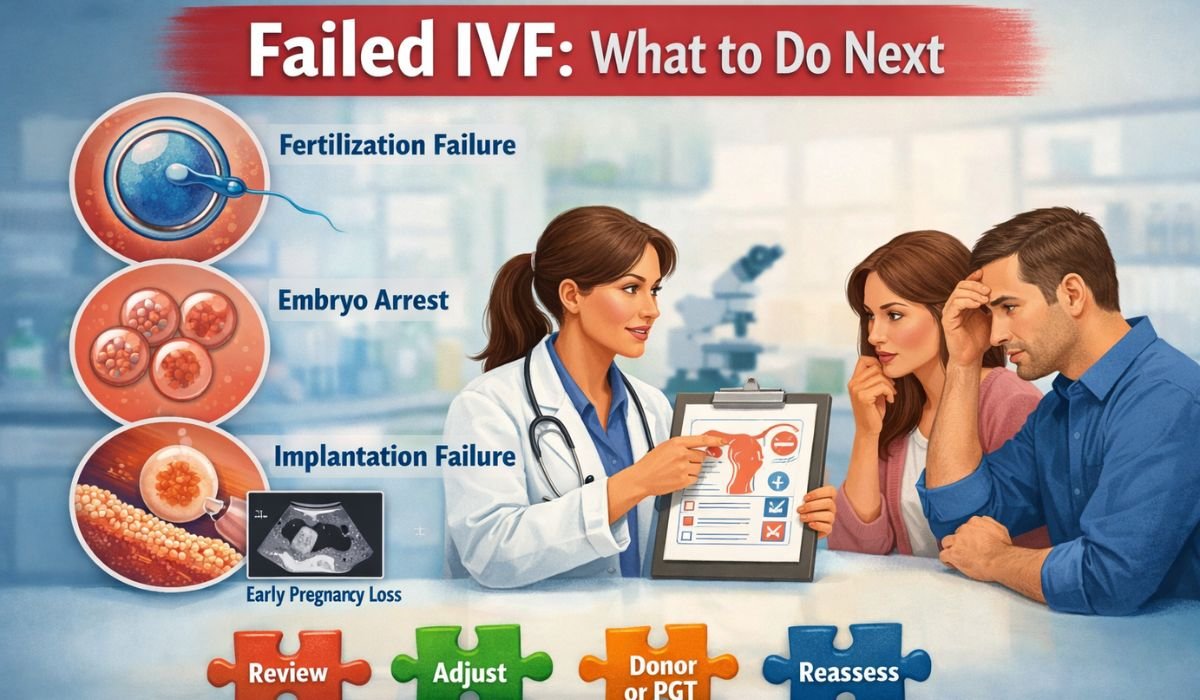
Failed IVF Cycles: A Medical Decision Guide on What to Do Next (Not Emotional Advice)
A failed IVF cycle means that fertilization, embryo development, implantation, or early pregnancy did not progress as expected. IVF failure is medically common and does not mean future treatment will fail. What does reduce future success is repeating IVF without understanding why the previous cycle failed.
This guide explains what to do after a failed IVF cycle, how doctors classify different failure types, what data actually matters, and when repeating IVF is medically reasonable—using clinical logic rather than reassurance. This is the evaluation-first approach followed at Rainbow IVF: analyze first, change strategy second, and proceed only when the data supports it.
IVF Failure: A Quick Decision Framework
-
No embryos formed → Review egg quality, sperm DNA integrity, and stimulation protocol
-
Good embryos, no implantation → Reassess transfer timing and endometrial preparation
-
Pregnancy occurred but ended early → Investigate chromosomal and uterine factors
-
Multiple failures without explanation → Stop repeating cycles and reassess strategy
This framework prevents emotionally driven decisions and focuses on correct next steps.
1. IVF Failure Is Common — Repeating It Without Analysis Is the Real Risk
IVF success is probabilistic. Even with good embryos and proper transfer, not every cycle results in pregnancy. One failure does not imply poor care or a hopeless prognosis.
The real risk begins when cycles are repeated without changing the underlying variables. Common reasons patients repeat blindly include:
-
No structured post-cycle review
-
Overreliance on “everything looked normal”
-
Pressure to act quickly without clarity
-
Confusing emotional urgency with medical urgency
A failed IVF cycle should be treated as clinical data. If the cause of failure is unclear, repeating treatment becomes guesswork.
2. What Must Be Reviewed After a Failed IVF Cycle
A structured post-failure audit is essential before considering another attempt.
Egg Factors: Quality Over Quantity
High egg numbers do not compensate for poor egg quality. Review:
-
Age-related oocyte competence
-
Response to the stimulation protocol
-
Egg maturity at retrieval
-
Indicators of oxidative or structural stress
Increasing medication doses without protocol change often worsens outcomes.
Sperm Factors: Beyond Basic Semen Analysis
Normal count and motility do not guarantee functional DNA.
-
Fertilization method used (IVF or ICSI)
-
Fertilization rate and abnormal fertilization patterns
-
Indirect indicators of DNA fragmentation
Repeating the same fertilization strategy after failure rarely improves results.
Embryo Development: Identify the Arrest Stage
Understanding where development stopped is critical:
Each stage suggests a different biological issue. Treating all failures the same leads to repeated disappointment.
Endometrial Factors: Timing Matters More Than Thickness
Endometrial thickness alone does not ensure implantation.
-
Hormonal preparation protocol
-
Synchronization with embryo age
-
Progesterone exposure timing
Calling the lining “perfect” without timing analysis is misleading.
Transfer Technique and Lab Conditions
Embryo transfer and lab handling significantly influence outcomes.
-
Transfer difficulty or uterine contractions
-
Catheter placement and timing
-
Culture conditions and embryo handling
Patients rarely see these factors, but they matter.
3. Different IVF Failure Types Require Different Solutions
Type 1: Poor or No Embryos
Common causes
What helps
-
Protocol modification (not escalation)
-
Addressing sperm-related factors
-
Egg-quality-focused strategies
What does not
Type 2: Good Embryos but No Implantation
This scenario is often oversimplified.
Possible contributors
Rational next steps
-
Adjusting transfer timing
-
Modifying endometrial preparation
-
Avoiding unnecessary immune or clotting tests without clear indication
Type 3: Pregnancy After IVF but Early Loss
This is biologically different from implantation failure.
Possible contributors
-
Chromosomal abnormalities
-
Luteal phase support issues
-
Undetected uterine conditions
Repeating the same approach without investigating miscarriage causes rarely changes outcomes.
4. Should IVF Be Repeated Immediately?
Repeating IVF can be appropriate—or harmful—depending on the situation.
Repeating IVF Makes Sense When:
-
A likely cause of failure is identified
-
The protocol will change meaningfully
-
Egg or sperm quality is potentially improvable
-
Time is not a critical limiting factor
Repeating IVF Is a Mistake When:
-
Multiple failures occurred with no explanation
-
Egg reserve is critically low and declining
-
The plan is simply “try again”
-
No clear change is planned
More cycles do not automatically increase success if the strategy remains unchanged.
5. Donor Options, PGT, or Taking a Break: Medical Logic Over Emotion
Donor Eggs or Sperm
Medically reasonable when:
-
Egg or sperm quality severely limits embryo development
-
Repeated cycles show intrinsic gamete issues
-
Time and age are major constraints
This represents a change in strategy, not a failure.
Preimplantation Genetic Testing (PGT)
Useful when:
Less useful when applied routinely without indication or to compensate for poor embryo development.
Taking a Break
Sometimes beneficial to:
6. Critical Questions After a Failed IVF Cycle — With Clear Answers
What exactly failed in my IVF cycle?
IVF failure usually occurs at one of four stages: fertilization failure, embryo development arrest, implantation failure, or early pregnancy loss. Identifying the exact stage is essential because each requires a different medical response.
What usually changes in the next IVF attempt?
A rational next attempt includes at least one strategic change—such as modifying the stimulation protocol, changing fertilization method, adjusting embryo transfer timing, or altering endometrial preparation. Repetition without change rarely improves outcomes.
What data from my last IVF cycle actually matters?
Objective data matters most: egg maturity and quality, fertilization rates, the stage of embryo arrest, endometrial preparation details, and transfer timing and technique. General reassurance is not a substitute for data.
When should IVF be reconsidered instead of repeated?
Reassessment is appropriate after multiple unexplained failures, progressive decline in egg or sperm quality, reuse of the same strategy, or when age and ovarian reserve limit benefit. Reconsidering does not mean stopping—it means changing direction intelligently.
What should not be repeated from the previous cycle?
Avoid repeating ineffective elements: the same stimulation protocol after poor egg quality, the same fertilization method after repeated failure, identical transfer timing after implantation failure, or cycles repeated without lab and transfer review.
7. A Structured, Non-Promotional Approach to Failed IVF
At Rainbow IVF, failed IVF cycles are approached with:
-
Detailed cycle audits rather than repetition
-
Protocol changes based on the identified failure type
-
Honest counselling that includes discussing limits, alternatives, and timing
The focus is informed decision-making, not cycle count.
Frequently Asked Questions About Failed IVF Cycles
What is considered IVF failure?
Failure occurs when embryos do not form, fail to implant, or pregnancy ends in early loss.
How many IVF failures are normal?
One failure is common. Repeated failures require deeper clinical evaluation.
Should IVF be repeated immediately after failure?
Only if a probable cause is identified and the treatment strategy is modified.
Can good embryos still fail to implant?
Yes. Implantation depends on embryo quality, endometrial timing, and transfer technique.
When should donor options be considered?
When repeated cycles show poor embryo development due to egg or sperm factors.
Final Takeaway
A failed IVF cycle is not the end. Repeating it without analysis often is.
The correct response is not urgency or optimism, but clarity—understanding what failed, what will change, and whether the next step is medically justified.
This content is for educational purposes and does not replace individualized medical consultation.